
Key takeaways
- Buyers trust a person before they trust a brand.
- The best content already exists: it is in your sales calls.
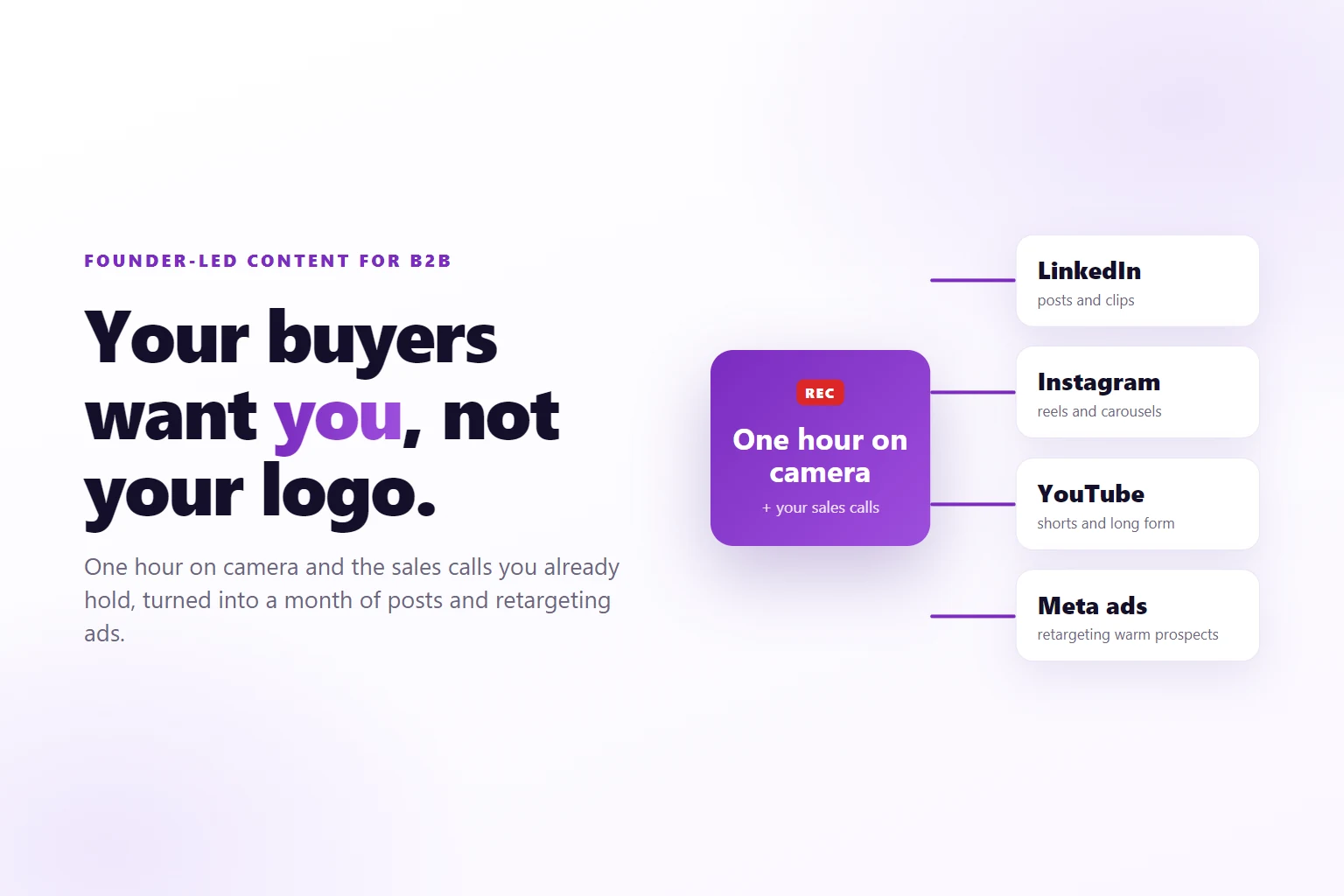
- One hour on camera can feed a month of posts on four channels.
- Retargeting with the founder’s face keeps warm prospects warm.
Founder-led content is marketing published in the founder’s own voice and face, answering the questions buyers actually ask, so prospects trust the person before the sales call, and the best pieces run as retargeting ads.
You are the best salesperson in your company. When you get on a call, deals close. When a prospect hears you explain how the thing works, they stop asking about price. And your marketing shows none of it. The ads have a logo. The posts were written from a brief by someone who has never been on one of your calls. Everyone tells you to post on LinkedIn, and nobody tells you when, because your calendar is already full of the calls that pay the bills.
Most advice on this stops at “post more” and leaves you to write it. That ignores the real constraint, which is your time, and it never connects the content to the sales calls you already hold or to the ads that follow your prospects around. I run my own content on a different method, built around one hour on camera, and the same method runs for B2B and expert-led companies with a sales team.
Grow faster with our solution.
Scrolled pastAn answer, in the founder's own words.
Booked callWhy buyers want the founder, not the logo
A B2B buyer is about to spend real money and tie part of their business to yours. So before they book, they check who they will be dealing with. A logo cannot answer that. A person can.
AI made this sharper. What changed when AI started making the ads is that the minimum quality of anything produced went up. A clean carousel, a polished post, a decent headline: anyone can generate those in minutes now, so they are the floor, not the edge. What nobody can generate is you, on camera, answering the exact doubt a buyer has, with a story from your own work.
A prospect who has watched you answer their objection arrives at the call half sold. They already know how you think, how you talk and whether they like you. The call stops being a pitch and becomes a check: does this person sound the same live?
A consumer brand can scale with a logo, because nobody books a call to buy a pair of socks. A B2B or expert-led business usually sells the person first. If your sales depend on a call, the founder’s face does the first part of the selling.
When the logo is fine: a self-serve product under a few hundred dollars that nobody talks to sales about. There, the product page does the selling.
What counts as founder-led content?
Founder-led content is anything published in your voice and with your face, built from what you actually said. A video of you answering a buyer’s question counts. A clip of your side of a sales call counts. A LinkedIn post written from your recorded words counts.
A ghostwritten thought-leadership post in a voice you never used does not count, even if your name is on it. Neither does a brand account posting stock tips. If someone else writes it, it has to be written from your recordings, or it is somebody else’s content with your photo on top.
There is a second test, and it is the one most founder content fails. Most businesses think marketing is advertising. It is not. The only goal of advertising is to bring eyeballs. The goal of marketing is to walk those eyeballs through the funnel until they get close to the sale. A post that gets views and stops there is advertising for yourself. Founder-led content earns its place when every piece has a next step: the next answer, the retargeting ad, the booked call. That is the funnel content feeds, stage by stage.
The real constraint is the founder’s time
Founders do not fail at content because they cannot talk. They talk all day. They fail because writing one good post takes an hour, editing one video takes an afternoon, and the calendar is full of calls. So the post never happens, or it happens twice and dies.
The fix is to design around time. You talk. I do the rest: the cutting, the copy, the publishing and the ads.
Here is how I did my own. On 2026-10-22 I sat in front of my camera, recording in OBS, the free recording software, and let an AI interviewer ask me questions podcast style. The interviewer was a voice agent built on ElevenLabs voice agents: an AI that holds a spoken conversation, loaded with my list of questions. It asked, it followed up, and I answered. About twenty minutes in, I asked how many questions were left. I did not like the answer. I answered two more and called it.
That recording fed several articles, this one included. The core stances in it, from “marketing is not advertising” to who should skip this, are things I said out loud that afternoon.
Talking beats writing for three reasons. A question forces a specific answer, so there is no blank page. Spoken answers carry the stories and the swearing that make it sound like you. And the founder needs zero preparation beyond showing up.
Your sales calls are the best content you have
Your sales calls contain the real objections, in the buyer’s own words, answered live by the person who knows the answer best. Most companies record every call and never open the recording again. That is the most persuasive material a company owns, sitting in a folder.
I use my own sales calls the same way. Short clips of my side of the call go out as content. The other person is never shown or named, and names, numbers and anything identifying stay out.
Each clip goes out four ways: an Instagram reel, an Instagram story, a YouTube Short and a LinkedIn post. Extra time on camera: zero, because the call already happened.
Buyer We tried ads before. The leads were junk.
Founder Because the ads were judged on leads. I judge them on booked calls.
Buyer Okay. How do you track that?
✂What makes a good clip:
- One objection, one answer. The buyer’s doubt is stated, and you answer it in under a minute.
- It ends on a completed thought. A clip that cuts mid-sentence reads as an accident.
- The buyer stays anonymous. Only your side goes out. Their face, name and company never do.
- It stands on its own. Someone who never saw the call understands what was asked and why your answer matters.
One rule before anything goes out: get the other person’s permission before their voice or face is published. Recording a call and publishing it are two different things, so ask for each one.
One hour on camera, four channels
The founder’s hour is recorded answers to questions I send ahead: a script of questions buyers really ask, read out and answered one per take. A phone or a laptop is fine. The questions look like this:
- How fast can we actually launch?
- What do most people get wrong at the start?
- Why did you start this company?
One question per take means every answer is already a standalone clip, so nobody has to dig a good minute out of a rambling hour. The AI interviewer is how I did my own; it is optional. A printed list works.
Where the questions come from matters more than the camera. They are questions buyers really ask, approved before recording, never questions a marketer thinks buyers should ask.
That is how my own Q&A runs. One recording becomes a long-form video and a set of shorts, each short posted to Instagram, YouTube Shorts and LinkedIn. YouTube’s Shorts help page allows Shorts up to three minutes; I keep mine under one, because the strongest stretch of an answer rarely runs longer.
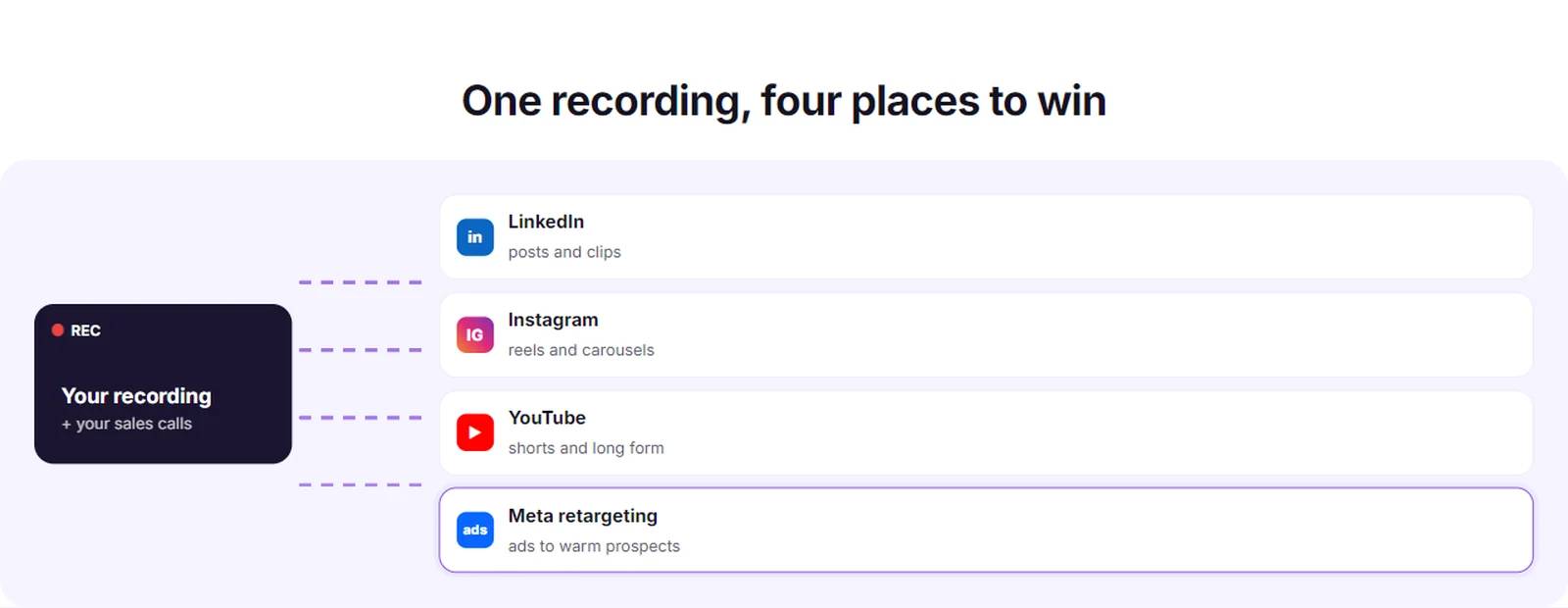
For a B2B company, the same method runs on about one hour on camera a month from each founder, plus up to 10 hours of the month’s sales calls. Out of that come 40 to 50 pieces a month, on three social channels plus the ads:
- LinkedIn: posts and clips. Every clip I put on LinkedIn gets its own written post, built from what was said in it.
- Instagram: reels and carousels.
- YouTube: shorts and the long-form cut.
- Meta ads: the best pieces, retargeted at warm prospects (people who already know you: they visited your site, watched or engaged).
40 to 50 pieces a month
The editing style rotates too. Every month I show 10 styles on my own sample videos, with what is trending rotated in, and the founder picks the ones they want. That is how the content process works, step by step. The volume side, making many versions fast, is how AI-made creative scales.
Turning content into retargeting ads
Retargeting means showing ads to people who already visited your site or engaged with you. Most retargeting is a stock banner that says “Still thinking about it?” and gets ignored.
I moved into marketing in 2014, writing copy. After every deliverable I kept asking the same question: what is the next step? The article got seen. Then what? Somebody clicked. Then what? The page loaded. Then what? Content has the same chain. A post gets seen once. Retargeting is the next step: the person who visited keeps seeing a real face and a real answer, until they book or buy.
On my own account, my posts also run as ads aimed at warm groups: people who visited my site and people who recently engaged with my Instagram, with anyone who saw me lately rotated out. For a company with a sales team, the best pieces go the same way, aimed at everyone who visited the site or engaged.
Three rules keep it working:
- Do not hit the same people over and over. Recent viewers rotate out of the audience.
- Rotate monthly. New questions, new calls, new clips, so prospects never see the same thing twice.
- Never change the winner. That is my number one rule. When a clip converts as an ad, it keeps running; the new ones get tested beside it.
The audiences are built on your pixel (the Meta tracking code on your site) and your ad account, so keep the ad account in your own business portfolio (the Meta container that holds your ad accounts, pages and pixel). The ads, the tracking and the pages are the ads and tracking side of the same system.
What it costs a founder in time each month
Here is the whole list of what a founder does:
- Once: share any recordings you already have (podcasts, webinars, interviews) and connect LinkedIn, Instagram and YouTube with one link, about two minutes.
- Every month: about one hour on camera from each founder, one question per take.
- Every month: pick the editing styles from 10 options.
- Every month: send up to 10 hours of sales calls you already held. That is not new time; the calls happened anyway.
- Every month: approve the posts you want.
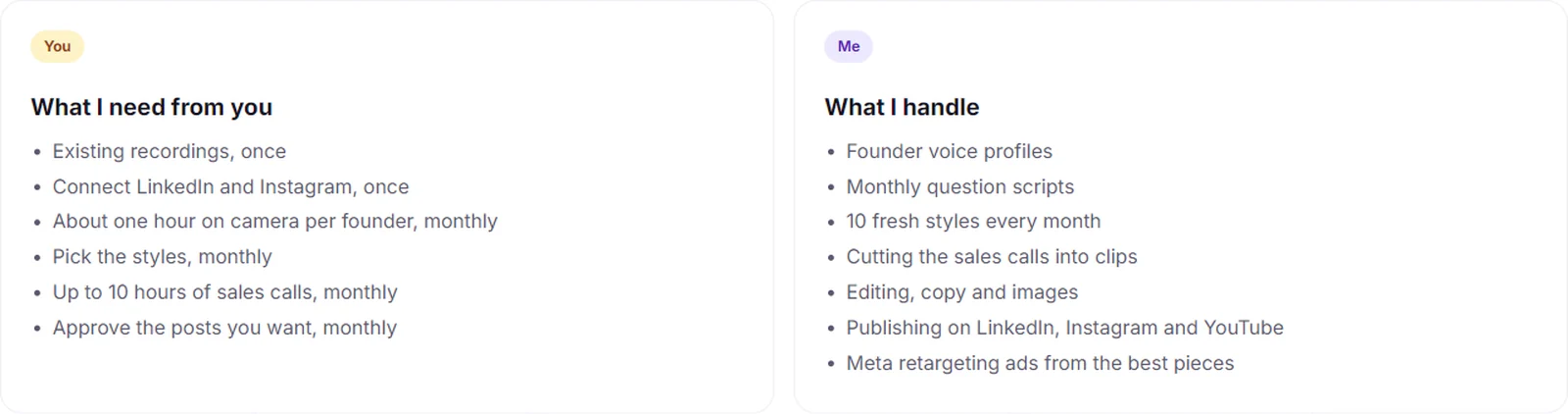
Everything else is mine: a voice profile of each founder built from their recordings (stories, opinions and the way they actually talk), the monthly question script, cutting the calls, editing, copy, images, publishing and the ads.
The one cost founders forget is that the hour has to happen. Book it like a sales call, same slot every month. A founder who keeps moving it gets no content that month.
When founder-led content is the wrong move
Founder-led content makes more of the right people see you and trust you. It cannot fix what happens after that. Skip it, or wait, when:
- The offer is not validated. Content brings attention to an offer. If the offer does not sell on a call today, more people hearing about it will not change that. Ads cannot fix a bad offer, and neither can a founder video.
- One sales rep and no room to add another. Retargeting with your face fills calendars. When the next free slot is three weeks out, the ads stop working, because nobody books a call for three weeks from now. Hire the second rep first.
- The founder will not give one hour a month. Then it is not founder-led content. A ghostwriter is a different product.
- A founder who will not accept breaking things. Building a company means breaking every single thing until it works. Some questions in month one will land and some will not. If every post has to be perfect before it ships, this will not work.
- Revenue under about $20,000 a month. At that stage the founder’s hour is better spent selling directly. This fits best from $100,000 a month and up, with a sales team taking the calls.
How to tell it is working
The signals are in the sales calls and in the ads, not in the follower count.
- Prospects mention a video. They quote your answer back to you, or open with “I saw you talk about this.” Ask on every call where they heard about you, and write it down.
- Shorter sales cycles. Fewer calls to close, because the first call starts half sold.
- Retargeting ads convert warm visitors. Booked calls from people who visited, left and saw you again.
- Booked calls by source. Tag every link with UTM parameters (labels on a link that tell you which post or ad sent the visit) and send the booked call back to Meta as a conversion through the Conversions API (Meta’s server-to-server link that reports what happened after the click). The Conversions API setup I use does that part.
Follower counts and likes are not the signal. A post seen by a few of the right buyers beats a viral one seen by people who will never buy.
Set the tracking up before the first post, so the read is honest from day one. Then read it after a full month of content, not after one post. And once the calls start booking, make sure people show up: getting booked calls to show is the next leak to close.
Frequently Asked Questions
How much of the founder’s time does this really take?
About one hour on camera a month, plus picking styles and approving posts. The recording is a list of questions buyers really ask, answered one per take on a phone or laptop. Sales calls you already hold supply the rest. Everything else, cutting, copy, images, publishing and ads, is done for you.
Does founder-led content work for B2B, or only for consumer brands?
It works especially well in B2B, because deals are bigger and buyers check who they will work with before booking. A prospect who has watched you answer their exact objection arrives at the call half sold. Consumer brands can scale with a logo; a B2B or expert-led business usually sells the person first.
Why use sales calls as content?
Because they contain the real objections, in the buyer’s words, answered live. That is the most persuasive material a company owns and it is usually never used again. Only the founder’s side is clipped and buyers stay anonymous. One answered objection can then reach every prospect who has the same doubt.
Where does the content get published?
LinkedIn, Instagram and YouTube, through the month, plus Meta retargeting ads built from the best pieces. The retargeting matters: everyone who visited the site or engaged keeps seeing a real face and a real answer instead of a stock ad, until they book or buy.
How do I know founder content is driving sales?
Watch what prospects say on calls and what the retargeting ads report. Booked calls from people who mention a video, shorter sales cycles, and retargeting ads that convert warm visitors are the signals. Follower counts are not. Track booked calls by source from the start so the read is honest.
Next step
Find out which of your calls are already content. This fits a B2B or expert-led business doing $100,000 or more a month, with a sales team taking the calls and a founder who sells well in person. On the call I look at what you record today, pull out the buyer questions that keep coming up, and map where each answer should go: a post, a clip or a retargeting ad. You leave with three things: the question list for your first hour on camera, the calls worth clipping first, and the warm audience to retarget first. See a founder’s calendar filled from ads: $100 a day in Meta ads filled the CEO’s calendar six weeks out in four weeks. Or read accounts with their real numbers.
Book a call about contentGet the ready-to-run version. The lesson for this post is in the Library inside Claude For Marketing, my community: the download, the paste block and what you get from it.
Get it in the Library