
Key takeaways
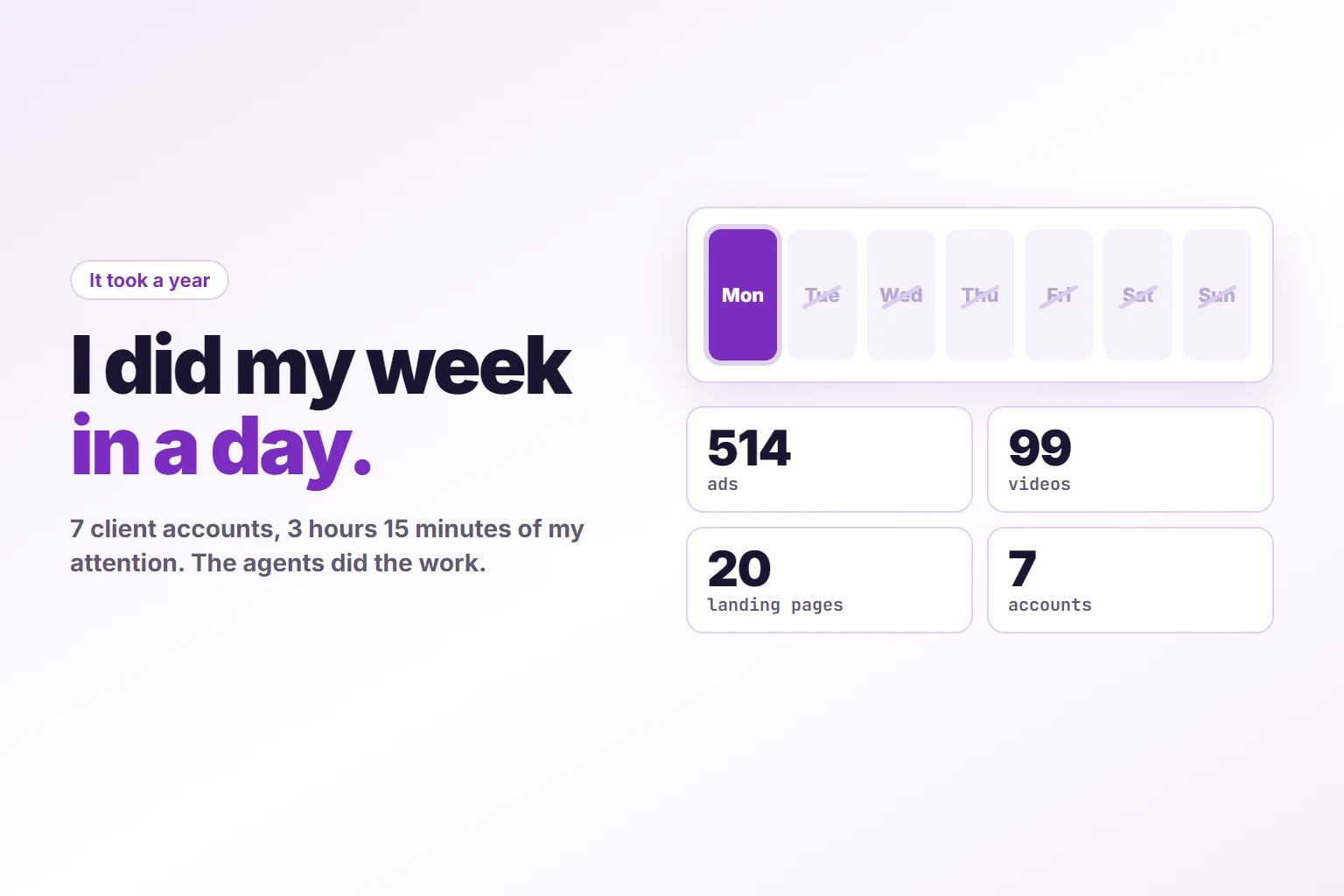
- One day handled 7 client accounts: 514 ads produced, 315 published, 99 videos rendered, 31 shipped, 20 landing pages.
- My part was 3 hours 15 minutes of decisions. The agents did the work on my system and came back for yes or no.
- I touch the work at two points only: I approve the plan, and I approve the last message to each client.
- Everything that broke became a rule in the system the same day, so it cannot break the same way twice.
- The freed days go to sales and to improving the system, which lands on every client at once.
A one-day delivery week is an agency week where AI agents do every client’s standard work on the owner’s own system, and the owner’s job shrinks to fast decisions: approve the plan, then approve the last message to each client. Everything between those two points runs without a human touching it.
If you run client work, you know the week. Monday is a pile. Every client wants something, every platform wants a click, and by Friday the work is done and nothing else is. No sales, no thinking, no making anything better.
On Monday, 26 October, I did my whole week of client delivery in one day. Seven client accounts. Ads, videos, landing pages and the weekly update to every client. At 20:34 I typed this to my agents, typos included:
“Its been a year since i have been trying to finish my whole week in a day. And I did… YOU did.”
One day of work. It needed the past year to be ready.
So this is the case study. The numbers, the system step by step so you can copy it, what broke, and what I do with the 5 days it gives back.
The numbers from one day
All of this is from one Monday, across 7 client accounts:
- 514 ads produced. 315 of them approved and published.
- 99 videos rendered. 31 shipped to clients the same day.
- 20 landing pages.
- 7 client accounts, around $20k a month of retainers, handled in one day.
- 6 hours building the system in the morning, then 3 hours 15 minutes of my attention for the whole delivery, which ran from about 3 pm to 8 pm.
- $136 of recorded agent cost. It ran on a Claude Max plan, so the real cost was quota.
The forecast for next week, and I am calling it a forecast: about 3 hours for the whole week. The morning of building is done, so next Monday the system runs as it is.
Monday, one day
Now read those numbers again with one thing in mind. I did not make one of those ads. Not one video. Not one page.
Where I fit: fast decisions
So what did I do for 3 hours 15 minutes? I made decisions.
The agents use my system. They read the protocols I wrote, they do the due diligence on every client, and they come back with “this is what we believe is best, based on your protocols”. I answer yes, no, yes, no, do X, do Y, do Z. They go and do it.
That’s the job now. Fast decisions. Not building ads, not uploading, not writing reports.
And I touch the work at two points only:
- I approve the plan. Before any agent builds anything, I see what every client gets this week and I say yes, no, or change it.
- I approve the last message to each client. Word for word. Nothing reaches a client that I have not read.
Everything between those two points runs without me.
- 1Approve the planMe
- 2Rank clientsAgents
- 3One agent per clientAgents
- 4Build and review adsAgents
- 5Go live, read backAgents
- 6Review pageAgents
- 7Approve the messageMe
One more design choice matters more than it looks. Custom work is split out on purpose. Anything outside the standard delivery goes on its own card and waits. Why? Because when a custom request sits in the same queue as the standard work, the custom thing eats the day, and the standard delivery, which is what every client pays for, does not get done. So the standard gets done first, every single week, and the extra waits its turn.
The system, step by step
This is the part you can copy. Seven steps, in the order they ran on Monday.
Step 1: A Monday dashboard ranks every client
At the start of the day, one page shows every client side by side: the last 7 days of results against their own 30-day average, spend, what was promised, what is still open. An agent ranks them. Whoever needs the most attention this week goes first.
The point is that I never start the week by opening 7 ad accounts one by one. The data comes to me, already sorted.
Step 2: I decide in rounds
The agents propose, I decide, and we do it in rounds. Each round is a list: new ads for this client, a budget change for that one, this video style, that page. I go down the list and answer yes, no or revise. The agents take the answers, do the work, and come back with the next round.
Rounds matter because nobody makes dozens of decisions in one sitting and makes them well. Small batches keep every single decision fast.
This is what we believe is best, based on your protocols:
Client A: new ads on last week's winning angleyes
Client B: move budget from the old ad set to the new oneyes
Client C: a long video, talking headno, do the cartoon style
Client D: no new ads this weekno, build them
Client E: review page with the 5 new reelsyes
Going. Next round when it's done.
Step 3: One agent per client, custom work on its own card
Once the plan is approved, one agent starts per client. Each one owns one client for the day and works from that client’s brief, history and rules. Custom work gets its own card on the board, so it never blocks the standard delivery.
I run all of this on OrcStrator, the app I built to run many Claude Code sessions as cards on one board. On Monday afternoon every client card fired at the same time.
Step 4: Ads built and reviewed in Nask AI
Every ad is built and reviewed in Nask AI, the ad platform I built. The agent writes the brief, Nask AI generates the concepts, and every concept is reviewed before it can be published. That’s how 514 produced becomes 315 published: the review throws out whatever does not pass.
The agents never hand-build ads with one-off scripts. The platform does the job the same way every time, which is the only way the volume stays safe.
Step 5: The ads go live, then get read back from Meta
Publishing is not the end. After the ads go live, the agent reads them back from Meta: how many exist, how many are actually running, which budgets changed. What my platform says happened is checked against what Meta says happened.
This step exists because something broke. More on that below.
Step 6: A review page per client, on the client’s own domain
Every client gets a private page on their own domain with the week’s work: the ads, the videos, the pages. Not a PDF buried in an email. A page they open on their phone, share with their team and come back to.
Step 7: The client message goes out last
The message to the client is the very last step, after everything is live and checked. I approve it word for word, then it goes. Seven clients, seven messages, the same day.
It’s last for one reason: a message that says “your new ads are live” has to be true when the client reads it.
What broke, and how each break became a rule
Monday was not clean. Four things broke, and every one of them became a rule in the system the same day.
- A client was set up under another client’s brand. Two clients shared one brand setting in the config. It was caught before anything was created under the wrong brand. Rule: the system now refuses to run two clients on the same brand.
- Ads were built but left off. The evening check found ads published but not switched on. Rule: a go-live step, a read-back from Meta, and a safety check before any client message goes out.
- One update went out before the change was made. A message described a change that happened minutes later. Rule: the message only goes after go-live, never before.
- A brief was missed. One client got no new ads because the box for ads was never ticked. It was rebuilt the same day. Rule: “no new ads this week” is now a line I have to approve, never a silent default.
This is the part people skip when they show off AI. Things break. What matters is what happens next. In a normal agency the same mistake happens again next month, because the fix lives in somebody’s head. In this system the fix is code, so the same break cannot happen the same way twice.
Would I still do this if the plans died tomorrow?
I run on a Max plan, so the real cost on Monday was quota, not dollars. I watch the API cost anyway, and I ask myself one question. If Anthropic killed the plans tomorrow and sold API access only, would I still do this work?
Yes. The recorded agent cost for the day was $136. That’s $136 to handle around $20k a month of retainers in one day. If that number tripled, I would still do it without thinking twice.
Never build a business on a price you cannot afford to lose. This is a price I can afford to lose a hundred times over.
The math: one day, six figures
So here is the math that changed how I see the business.
One day handled around $20k a month of retainers. Five days like this is six figures a month. And with the forecast of about 3 hours for the whole week, 2 days of work could carry a six-figure month.
In an agency the constraint was always hours. More clients meant more people, or more of my nights. Here the constraint is decisions, and decisions are fast. That’s a different business, not a faster version of the old one.
What the other 5 days are for
I work every single day, 7 days a week. The intense days are Monday to Saturday, and each one has one job:
- Monday: delivery. The whole week of client work, in one day.
- Tuesday: client meetings. All of them on one day, so they never break up the others.
- Wednesday to Friday: sales plus systems.
- Saturday: systems only.
So the 5 days after Monday come down to three things: clients, sales and the system.
Sales. Necessary for now. I hope it won’t always be.
Making the process better. Every day I’m not on delivery, I’m improving the system. For the past couple of months every client has been getting more, every single month, without asking: more benefits, more things, better results, more efficiency.
On those 5 days I’m working for all clients at the same time. One improvement to the system lands on every account the next Monday. I keep every client at the edge of what the technology can do today, no stone unturned. Which is why I call it what it is now: a research marketing agency. An R&D marketing agency.
That’s the whole point. I work much less so I can work much more, and bring a catastrophic amount of profit to every single client.
Every improvement made Wednesday to Saturday lands on every client the next Monday.
Proof: the consultant who needed 3 weeks
Here is what that looks like in real life. No names, because it’s not about the person.
A client hired an outside consultant to make a specific type of explainer video, the cartoon kind. The consultant works every hour of his week delivering for his clients and runs a team of 8. So it took weeks.
Before he was able to deliver, I had reverse-engineered the whole thing, produced it and delivered it. Higher volume, higher quality. And not one style: explainers, cartoons, an arcade game, even a music video. Here are six of them. The system made every one. I made none.
If we need another 5 from him, that’s another 3 weeks. I can deliver 50 tomorrow. And mine are not for one client. They’re for all of them.
The difference is not talent. I’m not making any of them. I build the process, which takes 10 or 20 times longer than doing it once. When it’s done, it’s a click of a button, for every client, every week.
$5,000 for 20 hours, or $5,000 for a button?
Would you rather pay somebody $5,000 to spend 20 hours managing your ads, or pay $5,000 for somebody to click a button and give you more results, better results, always competitive?
Most people still pick the hours, because hours feel like proof of work. They used to be. In the AI age, hours are what you pay for being behind. Being at the forefront of the technology is the whole game, and an agency that sells you its hours has every reason never to get there.
Hand it to Claude Code
You will not build my year in an afternoon. You can build the skeleton. Open Claude Code in an empty folder and paste this.
Read https://rodrigonask.com/ai-marketing-agency-week-in-one-day and build me the skeleton of the weekly delivery system it describes.

First ask me, one question at a time: my clients, what the standard weekly delivery is for each one, where their results live, and how I send each client their weekly update.

Then build, in this order, verifying each step before the next:
1. A clients file: one entry per client with their standard delivery, their channel for updates, and their rules.
2. A Monday dashboard: one HTML page that ranks every client by last 7 days of results against their own 30-day average.
3. A decision round: a list of proposals per client that I answer yes, no or revise, saved to a decisions log.
4. One task per client for the approved work, plus a separate task for anything custom, so custom work never blocks the standard.
5. A read-back check after anything goes live, comparing what was planned with what the platform reports.
6. A message draft per client, written last. Never send anything. I approve every message word for word.

Never use em dashes. Never send a message to anyone. Do not touch anything outside this folder.
When not to do this
If you have no standard delivery yet, do not automate anything. The system runs your protocols. Without protocols it has nothing to run, and you will automate chaos at scale.
If you have one or two clients, the build costs more than the hours it saves. Mine took a year. Build it when the same work comes back every week, for many clients.
And if what you want is to stop deciding, this is not for you. The agents do the work. The decisions stay with you. They come faster, not fewer.
If you want the bigger picture behind this, start with what an AI marketing agency actually does and the operating model in agentic marketing. The review step uses the same idea as scoring AI output in batches, my one-screen operating system is where the dashboards live, and the advisors that interrupt me are what keep custom work off delivery day. Real results from real accounts are in the case studies, the tiers are on services, and more build notes live on the blog.
To learn to build this yourself, join my community, Claude For Marketing, where I break down the agents, the Meta ads and the pages behind a week like this one. To have it done for you, click the second link: if you qualify, you book a call with me.
Open the lesson in Claude For MarketingHave it done for youDo the AI agents talk to my clients?
No. The agents draft the weekly message, but nothing reaches a client until I have read it and approved it word for word. The message is also the last step, after the ads are live and read back from Meta, so it can never promise something that has not happened yet. The agents do the work. The client relationship stays with me.
What does a day like this cost to run?
It ran on a Claude Max plan, so the real cost was quota. The recorded agent cost for the day was $136, for around $20k a month of retainers across 7 client accounts. I watch that number on purpose: if the plans disappeared tomorrow and only the API was left, the work would still make sense at that price.
What happens to custom requests from clients?
They go on their own card and wait. The standard delivery is what every client pays for, so it runs first, every single week, and nothing outside the standard is allowed to block it. A custom request still gets done, on its own track. It never eats the day the standard work needs.
Is the quality as good as a human team?
Every ad is reviewed before it can be published, which is why 514 produced became 315 published. Every launch is read back from Meta, and every client message is approved by me. On the one head to head I had, an outside team of 8 needed 3 weeks for a type of video I delivered first, at higher volume and higher quality.
Can I build this for my own agency?
Yes, but not in a weekend. Mine took a year, and the system is only as good as the protocols it runs. Start with one standard delivery you repeat every week, write down how you decide, then hand each step to an agent and keep the plan and the final message for yourself.