
Key takeaways
- AI does the volume; a person still owns the offer and the number.
- Most agencies bolt AI onto the old team; the price stays agency-sized.
- The test is creative volume plus tracking to the sale.
- With AI doing the volume, one accountable operator can replace a team.
An AI marketing agency runs a client’s paid acquisition with AI doing the volume work, ad variations, copy and reporting, while people own the offer, the strategy and the numbers, so the client gets more tested creative for less money.
You have three proposals open. All three say AI. One promises AI-powered personalization. One has an “AI strategist” on the team page. The third says its creative (the finished ads: the image or video plus the copy) is AI-built, and the retainer is the same number as last year’s. You cannot tell which of them would change anything in your ad account.
I can answer that one from both sides of the desk. I ran a 10-person marketing agency. Today it is one person, me, plus systems and AI, running the whole account from the offer to the sale. So here is what an AI marketing agency does when it is doing the job, line by line: what the AI makes, what a person still decides, how many ads you should see in a month, what it costs, and when one operator beats the whole agency.
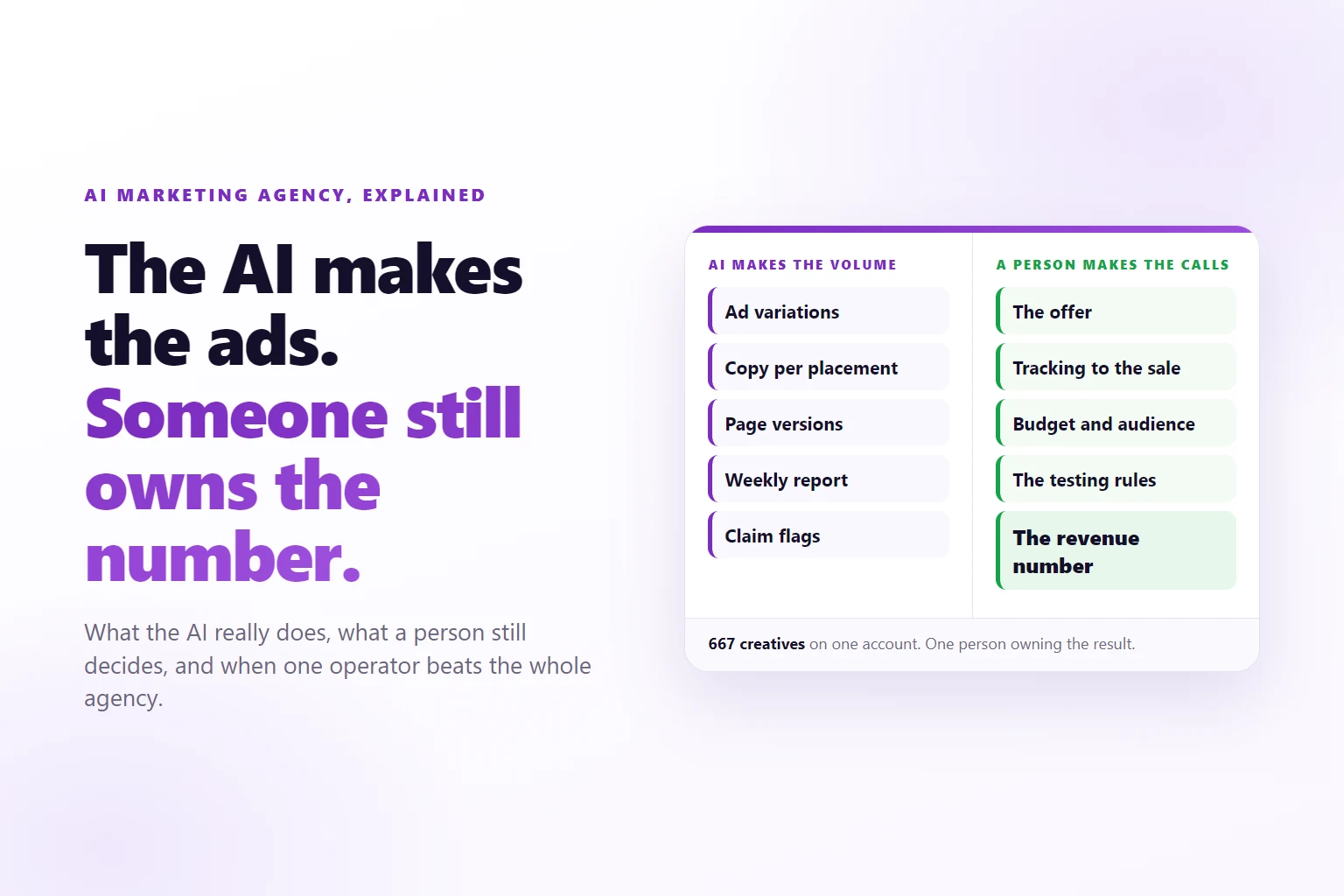
AI makes the volume
A person makes the calls
Who this is for
This is for the founder of a business doing $100,000 or more a month in revenue. You have paying customers, a sales team to take the calls, and a monthly budget for ads. You have probably tried an agency or a freelancer already, and now everyone pitching you has added the word AI to the deck.
It is not for three kinds of business.
- Under about $20,000 a month in revenue, it does not make sense. More ad volume is rarely the bottleneck. The offer is, or the founder’s own selling. AI makes more ads; it does not make a weak offer sell.
- One sales rep and no plan to add another puts a ceiling on the whole thing. I have filled client calendars so fast that the next free slot was three weeks out. At that point the ads stop working, because nobody books a call for three weeks from now.
- A first-time founder who will not accept breaking things will hate this. Testing at volume means most ads lose.
Past those three, the rest of this page is about what you are buying.
What does an AI marketing agency actually do?
An AI marketing agency runs your paid acquisition (paying a platform like Meta to put your ads in front of strangers, then turning some of them into booked calls and sales), with AI producing the volume of work and people owning the decisions.
The work splits into two piles. The volume pile is everything that used to need hands: ad images, videos, headlines, copy for every placement, landing page versions, the weekly report. The decision pile is everything that needs judgment: what you sell and at what price, who the ads are for, how much to spend, what counts as a win, and the revenue number at the end.
Here is what changed when AI started making the ads. The minimum quality of anything produced went up. A decent ad used to take a designer and a copywriter most of a day. Now a decent ad is the floor, and the floor is worth nothing. The people who did not get better fast enough are out of the market already. Research says the same thing from the other end: in the NBER study of generative AI at work, the biggest gains went to the least experienced workers, which is exactly what a rising floor looks like.
So where is the gap now? In the system around the AI. I spend 30 hours a week improving the system every client runs on. A paid media manager or a copywriter at an agency works 30 to 50 hours a week inside the craft, on client work, and gets tiny improvements because nobody pays them to work on the craft. That is why so many “AI agencies” look identical to the old ones. Same people, same week, a new tool in the corner.
If you want the operating model in full, I wrote about what AI marketing is and how it replaced my agency.
What the AI does, and what still needs a person
The AI does the volume. A person does everything that decides whether the volume makes money. Here is the split I run, line by line.
| The work | Who does it | Why |
|---|---|---|
| Ad variations: images, videos, hooks | AI | Volume. A hook is the first line or first two seconds that stops the scroll. |
| Copy for every placement | AI | Each placement wants its own length and format. |
| Landing page versions | AI builds, a person approves | Pages are cheap to make now; a broken one is expensive. |
| The weekly report | AI pulls the numbers, a person reads them | Pulling data is volume. Deciding what it means is not. |
| Claim checks on every ad | AI flags, a person signs off | The AI catches most of it. The signature stays human. |
| The offer and the price | A person | Ads cannot fix a bad offer. |
| Tracking to the sale | A person | It decides what the platform learns. |
| Budget and audience | A person, with the platform | The platform finds people; a person sets the limits. |
| The testing rules | A person | The framework decides what a test can prove. |
| Picking the winning ad | The platform, not anyone’s taste | Spend and sales pick it. |
| The revenue number | A person | Somebody has to own it, or nobody does. |
Three of those lines need more than a row.
The offer. A great ad on a bad offer is a fast way to lose money. A great ad on a good offer with bad economics is a slower way. If a customer takes a year to pay back what they cost to acquire, more ads make the cash problem bigger, faster. No AI decides that for you.
Tracking to the sale. Tracking is the record that connects a sale to the ad that started it. Most accounts stop at the pixel, the snippet on your site that reports visits and form fills to Meta, plus offline conversions, which are sales uploaded to Meta after they close, usually through the Conversions API (Meta’s server-to-server channel for sending those events). What they never send is the predicted value of each lead. If 1 lead in 20 becomes a sale, each lead is worth 5 percent of your average sale, and that value is what you tell the platform. I wrote up the server-side tracking I set up in a separate post. Without it, an AI making hundreds of ads is teaching the platform to find cheap leads, not buyers.
The testing rules. Creative testing means running many versions of an ad at once, under fixed rules and budget, so spend and sales show which one works instead of anyone’s opinion. The framework you test inside matters more than whatever you are testing. Without one, volume does not save you. You get hundreds of ads and no answer.
On my accounts the AI part is Nask AI, the software I built. Every creative on my plans with AI-built creative is real output from it on a real client account. What it does not do is decide the offer, own the tracking or sign off a claim. That is me.
How many ads should AI produce in a month?
Enough that the platform picks the winner, not you. On most accounts that means hundreds of new creatives a month, not four.
The reason is how Meta delivers ads now. Andromeda is Meta’s newer ad-matching system, the part that decides which ad each person sees. It punishes accounts that run a few hand-picked creatives against narrow audiences, and it rewards accounts that feed it volume and let it find the signal. Four ads a month tells you nothing. Sixty a week found the three angles that worked on the account below.
Most accounts I inherit have never tested at that scale. So after fixing tracking, my second move on any account is the same: launch far more creatives than anyone there thought was reasonable.
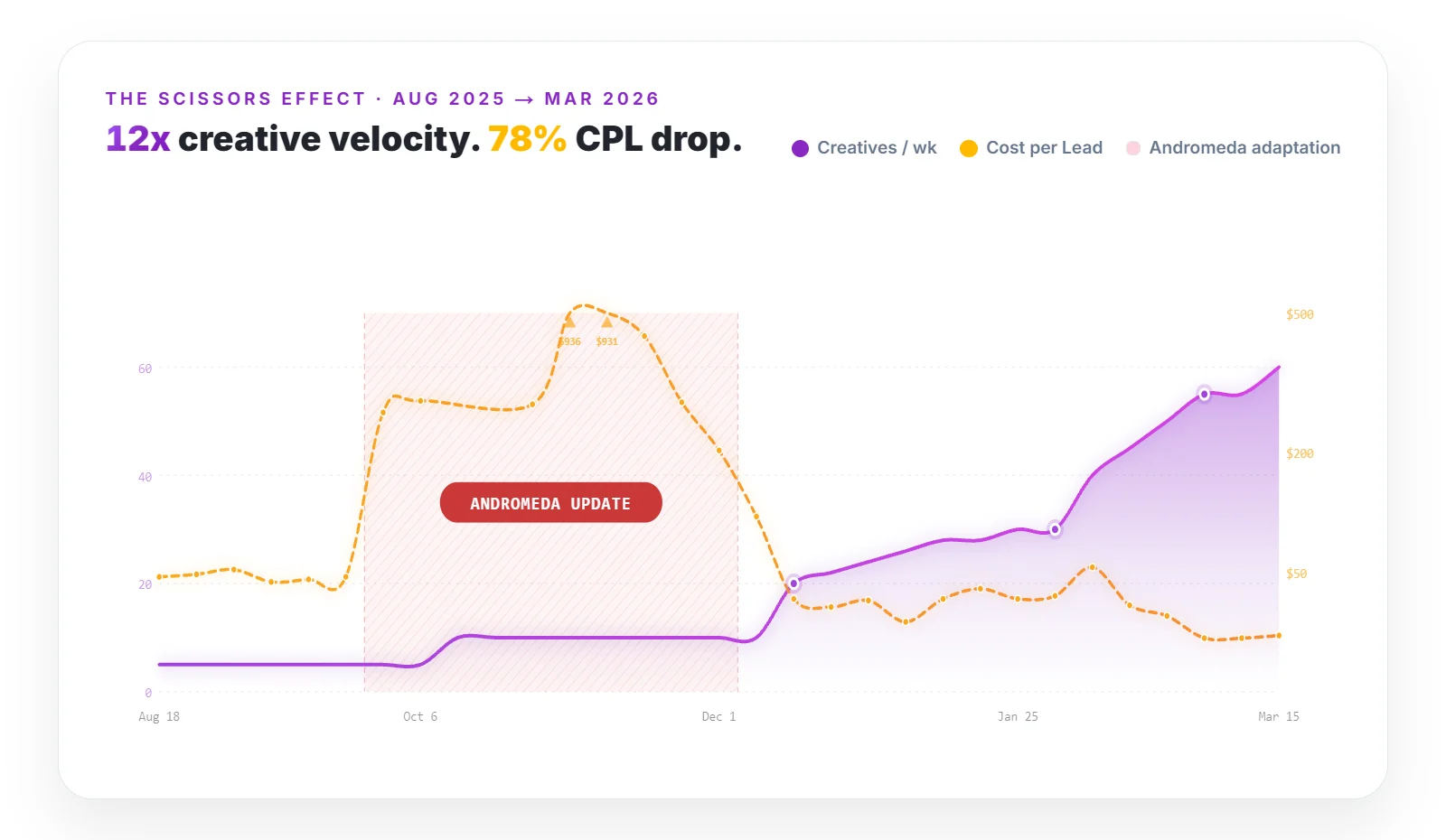
Here is what that looked like on one account, a B2B productivity software company buying trial signups from cold audiences. The account was producing leads in the mid-$40s each, like clockwork. Then Meta rolled out Andromeda, and the cost per lead jumped 6 to 20 times overnight. I did the opposite. I stopped picking winners and started flooding the feed: five creatives a week became sixty.
Creatives shipped
0Cost per lead
$45 to $10
down 78% on spend that stayed flat
Spend stayed flat at around $800 a week. The cost per lead fell from $45 to $10, a 78 percent drop, and the best week came in at $6.17 a lead. Out of more than 20 angles (an angle is the reason to buy that an ad leads with), three survived. A plainer landing page, built after about 20 versions, lifted signups 4x. Across the engagement I shipped 667 creatives.
Volume is the measurable difference, but it is not the whole method. My number one rule inside the framework is never change the winner. Once an ad wins, you do not edit it, duplicate it into a new structure or swap its copy. New ideas go in as new ads next to it. Most accounts change the winner without realizing it, and the result disappears with it.
What does an AI marketing agency cost?
Expect a monthly fee plus your ad budget, and judge the fee by the output it buys, not by the word AI in the proposal.
There are two kinds of AI agency, and the invoice does not tell you which one you hired.
The first kind bolts AI onto the old team. Same account manager, same media buyer, same designer, now with a tool that does half their hours. Their cost drops. Your price does not. Your output does not change either, because nobody redesigned the work around the tool. The AI is real. It works for their margin, not for you.
Agency invoice Before AI
Agency invoice After AI
The second kind rebuilt the work around the AI, so what you get changes: more ads, more pages, faster changes, the same or a lower fee. That is the only kind worth paying for.
Here is how I price it, from my public page. The plans run from $2,900 to $9,000 a month, plus 10 percent of ad spend above $10,000 a month, with ad budgets starting at $5,000 a month. If you want the thinking without the hands, one-to-one consulting starts at $300 an hour.
The comparison table on that page puts fee and output side by side.
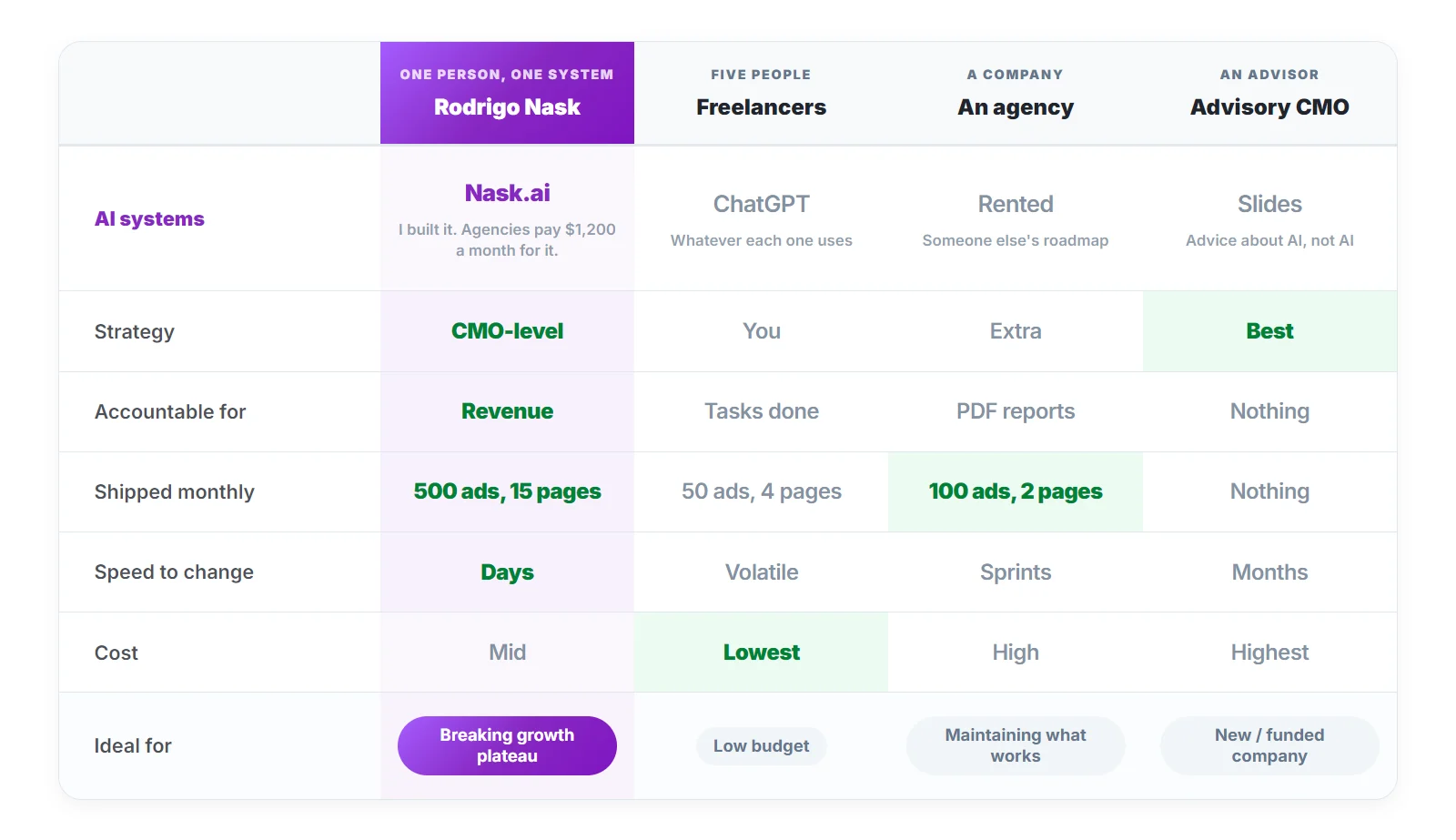
In a month that table has me shipping 500 ads and 15 pages, a group of five freelancers 50 ads and 4 pages, and an agency 100 ads and 2 pages. Divide the fee by the ads and the pages that went live. That number tells you more than any line on the proposal.
AI agency, traditional agency or one operator?
For paid acquisition into a sales team, one accountable operator with AI usually beats both. The obvious answer, that more people means more capacity, is wrong here.
Most of an agency’s headcount existed for volume. Copywriters, designers, a video editor, someone building pages, an analyst assembling the report. AI now covers that volume. What is left is the part that was always the hardest to staff: one person who sees the whole funnel and is accountable to revenue.
The operator
One person. The whole account.
Offer, tracking, testing rules and the revenue number. The system makes the volume.
That person matters because of the handoffs. When marketing and sales sit in different companies, the agency says the leads are great and the closing is the problem. The sales team says the closing is great and the leads are garbage. Both are partly right and neither owns the sale. One owner from the first ad to the sale ends that argument, because there is nobody left to blame.
Few people take that job, because it is hard. You start as a specialist, mine was technology and ads, then you spread into copy, sales, pages and conversion rate work until you can run every step yourself. It took me about a decade. AI did not shorten that decade. It removed the need for a team underneath the person who finished it.
An agency is still the better buy in three cases:
- You need many channels running at once (TV, retail, events, five social networks) more than you need one sales engine.
- You need a brand team: identity, campaigns, a creative director with a point of view.
- You need bodies in meetings across a large organization.
If none of those is you, you are paying for a structure built around volume that software now produces. The same split runs after the ad, too: in the show-rate system for booked calls, the reminders run themselves and I own the rules.
Where AI marketing goes wrong
AI marketing goes wrong in five predictable places, and none of them is “the AI is not good enough”.
Generic output. AI copies whatever it is fed. Feed it a generic prompt and you get the same ads as everyone else in your market. Feed it the founder’s own words and the answers real buyers give on sales calls, and the ads sound like your business. The input is the difference. The same raw material, the founder talking, is what founder-led content is built on.
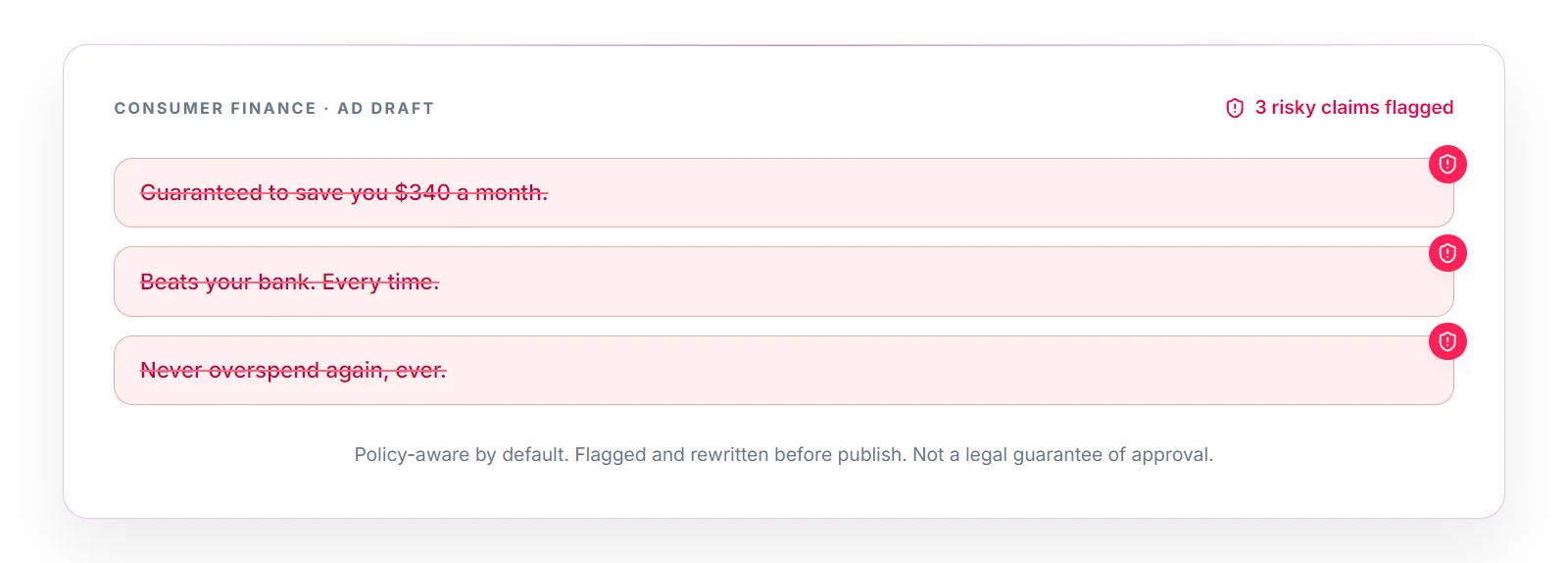
Invented claims. Give the AI permission to invent an illustrative example and it will abuse that permission every single time. A made-up statistic, a testimonial nobody said, a result nobody got. My rule: every statistic, claim and testimonial in generated copy has to come from evidence the client gave me. If the evidence does not exist, the copy does not mention it. Fake testimonials are not a gray area either; the FTC guides on endorsements and testimonials say they have to reflect real experience.
Changing the winner. Someone edits the winning ad’s headline, or duplicates it into a fresh campaign to “scale” it, and the result disappears. Never change the winner.
Volume without a framework. Hundreds of ads with no rules about budget, time and what counts as a win produce a lot of spend and no answer. Volume works inside a framework, not instead of one.
Tracking that stops at the lead. An AI making ads at volume on top of tracking that only reports form fills will get you very cheap, very bad leads. The platform optimizes for whatever you tell it to count.
None of these is solved by a better model. They are solved by the person who owns the account. HBR on generative AI and creative work draws the same line from the research side: the AI widens the pile of ideas, and people still decide which ones are worth anything.
How to vet an AI marketing agency
Ask three questions in writing, then ask to see the evidence. A sales call is where everyone sounds good. A written answer is where you can hold them to it.
> How many new ads run each month?
FAIL "As many as the account needs."
PASS "Hundreds. Here is last month from a live account."
> Who owns the offer and the revenue number?
FAIL "Our team collaborates on that."
PASS "One named person. Me."
> Show me a sale tied to an ad.
FAIL "Here is our click report."
PASS "Ad, lead, booked call, sale. Same row."
- How many new ads will run each month? You want a number in the hundreds and a month of real creative from a live account to back it. “As many as the account needs” means the AI is for their margins.
- Who owns the offer and the revenue target? You want one named person. “Our team collaborates on that” means nobody.
- Can you show me the tracking that ties a sale to an ad? You want to see an ad, a lead, a booked call and a sale on the same row. A click report is not that.
Then two follow-ups that separate the real ones fast:
- How do you protect a winning ad? If they do not have an answer, they change winners.
- How do claims get checked before an ad spends money? If the answer is “the AI is very good”, nobody checks.
And one thing to look at yourself: what the numbers should be. My funnel benchmarks, stage by stage show the cost and conversion rate each step should produce once the account is working, so you can tell whether the proposal is promising something real.
Frequently Asked Questions
Is an AI marketing agency better than a traditional one?
It is better when the AI changes what you get, not only what the agency spends internally. Many agencies use AI to cut their own costs and keep the same price and output. The useful version gives you far more tested ads, faster, with tracking that shows which ones sold. Ask to see a month of creative from a live account.
What does the AI actually do in an ad account?
It writes and designs ad variations from the founder’s own words, produces copy for each placement, and speeds up reporting. It does not decide the offer, choose the audience strategy or own the revenue number. In the accounts I run, the AI makes the volume and I make the calls, which is why hundreds of creatives a month are possible.
Can one person with AI replace an agency?
For acquisition, often yes. The work that needed a team was mostly volume: designs, copy, variations, reports. AI now covers that volume, so one accountable operator can plan, build and run the account. An agency still makes sense when you need many channels at once or a brand team, not a sales engine.
What can go wrong with AI-made ads?
Generic output and broken claims. AI copies whatever it is fed, so ads built from generic prompts all sound the same, and unchecked copy can promise things that get ads rejected. The fix is feeding it the founder’s real words and real sales call answers, then a human review before anything spends money.
How do I vet an AI marketing agency?
Ask three things in writing. How many new ads will run each month? Who owns the offer and the revenue target? Can you see the tracking that ties a sale to an ad? Vague answers to the first question mean the AI is for their margins. Vague answers to the last two mean nobody owns the result.
Next step
See what AI would make in your account before you sign anything. This fits a business at $100,000 or more a month, with a sales team to take the calls and a budget to spend. The call is a walk through your account and your numbers, and it produces one thing: how many ads a month you should be testing and what your tracking has to send before that volume pays off. See the volume proof in 667 creatives on HyperTask, read the rest of the case studies, or see how I work one to one on the consultancy page.
See what AI would do in your account